
Depo-Provera Meningioma Surgery: What to Expect Before, During, and After Craniotomy
Published May 9, 2026
The Short Answer
If you used Depo-Provera for a year or more and needed surgery for a meningioma, every dollar of your surgical costs — and every week you couldn't work — is a recoverable damage in your lawsuit. This guide covers the craniotomy process from pre-op to rehabilitation, and explains exactly how surgery strengthens your legal claim against Pfizer.
Lisa's Story: 9 Years on Depo-Provera, Then a Grade II Meningioma
Lisa T. was 52 years old when she started having persistent headaches that she assumed were tension-related. She had been using Depo-Provera since her early forties — nine years of quarterly injections with no problems she could see. Her primary care doctor ordered an MRI as a precaution. The result came back as a 3.4 cm Grade II meningioma in her left frontal lobe.
Her neurosurgeon recommended craniotomy. The surgery was scheduled for six weeks later. In the meantime, Lisa was told to stop working — she was a school administrator and couldn't safely manage her responsibilities with the cognitive effects of the tumor pressing on her brain.
"I had no idea Depo-Provera could cause a brain tumor," Lisa said. "Nobody warned me. I used it for almost a decade and thought it was safe." After speaking with a mass tort attorney during recovery, Lisa learned that her entire medical journey — from diagnosis through surgery and rehabilitation — represented substantial recoverable damages in the Depo-Provera MDL.
"The tumor was inside my head. The surgery was terrifying. When I found out the shot I trusted for nine years may have caused it — that changed everything for me."
Understanding Meningioma Surgery: Your Options
Not all meningiomas require immediate surgery. But when a tumor is growing, causing symptoms, or classified as Grade II or Grade III, neurosurgeons typically recommend surgical resection. Here are the primary treatment pathways:
Craniotomy
Open surgery where a portion of the skull is temporarily removed to access and resect the tumor. Standard of care for most symptomatic meningiomas. Most complete resection possible.
Stereotactic Radiosurgery
Gamma Knife or CyberKnife — focused radiation without opening the skull. Used for small tumors or those in difficult locations. Not true surgery but still a significant medical intervention.
Active Surveillance
For small, asymptomatic Grade I tumors, periodic MRI monitoring without immediate intervention. Ongoing imaging costs and the psychological burden of monitoring are still compensable damages.
Phase 1: Before Surgery — Pre-Operative Preparation
The weeks before craniotomy involve extensive preparation. Understanding what happens helps you document everything that should go into your legal claim.
Advanced Imaging (MRI with Contrast, MR Angiography)
Your surgical team needs detailed imaging to map tumor location, size, and proximity to blood vessels and critical brain structures. These scans typically cost $2,000–$5,000 each and are recoverable damages.
Neuropsychological Baseline Testing
Cognitive function tests establish your baseline before surgery so doctors can measure post-surgical changes. This documentation also creates a legal record of how the tumor impaired you before treatment.
Pre-Op Medications and Medical Clearance
Surgeons typically prescribe corticosteroids to reduce brain swelling before surgery, anti-seizure medications, and sometimes embolization (blocking blood supply to the tumor) 24–48 hours pre-op. All medication costs are recoverable.
Work Leave Documentation
Begin documenting lost income immediately. If your employer requires FMLA paperwork, complete it. Lost wages from pre-surgical work restrictions through full recovery can represent $20,000–$100,000+ in damages depending on your salary.
Phase 2: During Surgery — What Happens in the OR
Craniotomy for meningioma typically takes 4–8 hours depending on tumor size and location. Knowing what occurs helps you contextualize the severity of your medical intervention for legal purposes.
The Craniotomy Procedure — Step by Step
General anesthesia administered. Intraoperative monitoring electrodes placed to track brain function in real time.
Scalp incision made and retracted to expose the skull over the tumor site. A small section of skull (bone flap) is removed using a surgical drill.
Dura mater (brain's protective covering) is carefully opened. The surgeon uses microscopy and neuronavigation to locate and dissect the tumor.
Tumor is resected — as much as safely possible without damaging surrounding tissue. Grade II and III tumors may require more aggressive resection with higher risk.
Bone flap replaced and secured with titanium plates or sutures. Scalp closed. Patient transferred to ICU or neurology intensive care for immediate monitoring.
Phase 3: After Surgery — Recovery Timeline
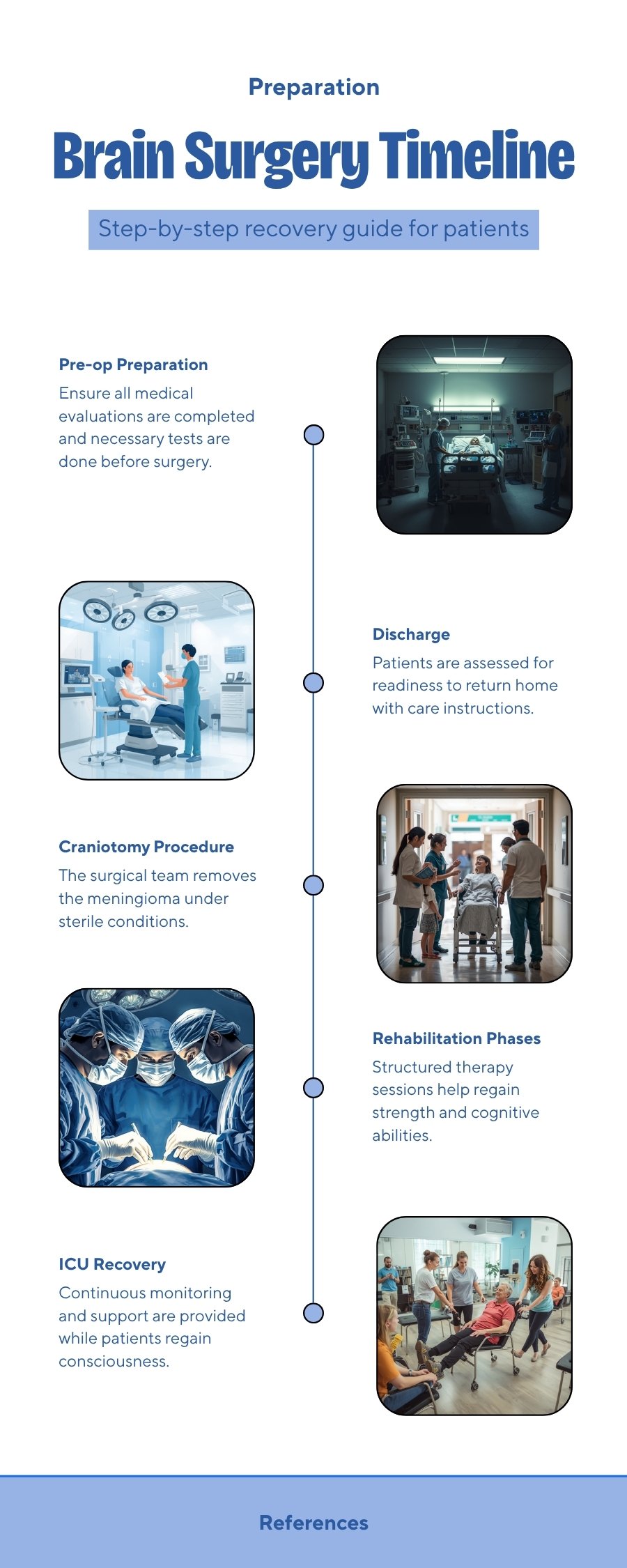
Days 1–3: ICU / Neurology Intensive Care
Continuous monitoring for seizures, stroke, bleeding, and swelling. Neurological assessments every 1–2 hours. Pain management. Initial cognitive and mobility evaluation.
Days 3–7: General Neurological Ward
Transfer from ICU once stable. Early physical and occupational therapy begins. Wound care. Anti-seizure and steroid medications continue. Discharge planning begins.
Weeks 2–6: Home Recovery
No driving. Limited activity. Fatigue is the dominant symptom. Outpatient follow-up visits every 1–2 weeks. Post-operative MRI at 3 months. Most patients cannot return to work during this phase.
Months 2–6: Rehabilitation
Cognitive rehabilitation for memory and executive function. Speech therapy if speech was affected. Vestibular therapy for balance. Physical therapy. Vision therapy if vision was impaired. Many patients return to work part-time during this window.
Months 6–12+: Long-Term Monitoring
Annual MRI for Grade I, more frequent for Grade II/III. Anti-seizure medications may continue for years. Radiation therapy for residual tumor if incomplete resection. Neuropsychological re-testing to measure cognitive recovery or ongoing deficits.
Surgery Costs as Lawsuit Damages
Every dollar you spend because of your meningioma — and every dollar you didn't earn while recovering — is potentially recoverable in your Depo-Provera lawsuit. Here's how surgical costs translate into compensable damages:
| Damage Category | Typical Cost Range | Compensable? |
|---|---|---|
| Craniotomy (surgeon + hospital) | $50,000–$150,000 | Yes |
| Pre-operative imaging (MRI, MRA) | $2,000–$8,000 | Yes |
| ICU and hospital stay | $10,000–$40,000 | Yes |
| Rehabilitation (PT, OT, speech, cognitive) | $5,000–$30,000 | Yes |
| Medications (steroids, anti-seizure) | $500–$5,000/year | Yes |
| Lost wages during recovery | Varies by salary | Yes |
| Future monitoring MRIs | $1,500–$3,000/year | Yes |
| Pain and suffering | Multiplied by severity | Yes |
Cost ranges are illustrative estimates. Actual recoverable damages depend on your specific medical history and case facts.
If You Had Radiation Instead of (or After) Surgery
Stereotactic radiosurgery (Gamma Knife, CyberKnife) and conventional fractionated radiation therapy are both significant medical interventions that generate substantial recoverable damages. Many Grade II meningioma patients receive radiation after surgical resection to reduce recurrence risk.
Radiation Damages Include:
- Radiosurgery procedure costs ($15,000–$50,000)
- Treatment planning sessions (multiple visits)
- Radiation side effects treatment
- Cognitive effects from radiation
Long-Term Radiation Risks:
- Radiation-induced cognitive decline
- Necrosis of surrounding tissue
- Hair loss over treatment area
- Future tumor transformation risk
Frequently Asked Questions
Does having surgery make my Depo-Provera lawsuit stronger?
What is the difference between craniotomy and stereotactic radiosurgery?
Can I file a lawsuit while I am still recovering from surgery?
What if my surgery didn't fully remove the tumor?
How long does meningioma surgery recovery typically take?
I had surgery years ago. Can I still file a lawsuit?
Related Depo-Provera Legal Guides
Just Diagnosed? Your 30-Day Action Plan
Critical steps in the first 30 days after a meningioma diagnosis linked to Depo-Provera.
Evidence GuideWhat Evidence Do You Need?
The complete guide to medical records, pharmacy records, and documentation that builds a strong case.
Medical GuideMeningioma Grades I, II & III Explained
How your tumor grade affects both your health outlook and your lawsuit's settlement value.
Timeline GuideHow Long Does a Depo-Provera Lawsuit Take?
A realistic filing-to-payout timeline covering every phase of MDL litigation.
Your Surgery Is Evidence. Your Suffering Has a Dollar Value.
Every hour in the OR, every day in the hospital, every week you couldn't work — these are documented damages in your Depo-Provera lawsuit. A free case review takes 20 minutes and costs you nothing.
Get Your Free Case Review →Contingency fee — you pay nothing unless we win. No upfront costs. No obligation.