How Long Does a Depo-Provera Lawsuit Take? A Realistic Timeline from Filing to Payout
Published May 9, 2026
The Short Answer
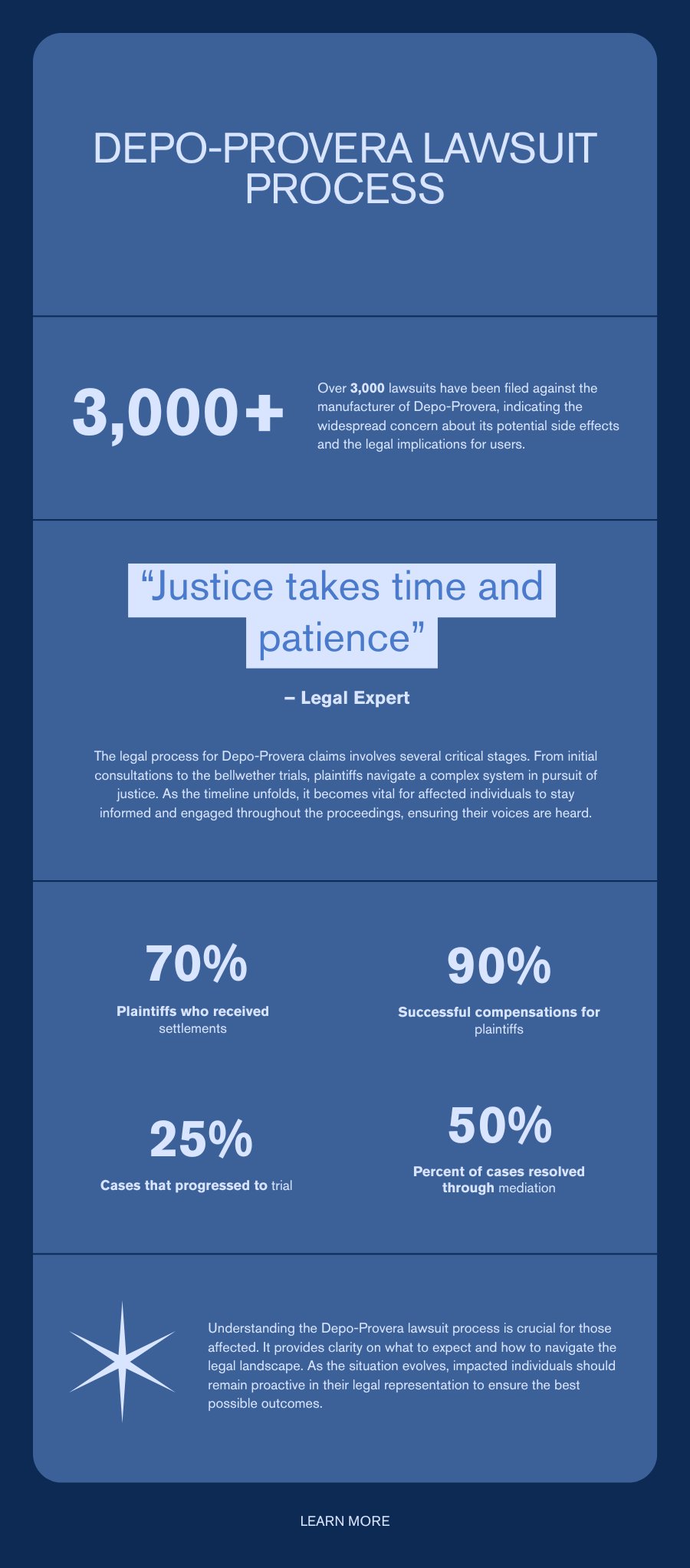
A Depo-Provera lawsuit filed today will likely take 3–5 years from start to settlement check. That sounds long, but the MDL's critical milestones — Daubert in June 2026, bellwether trial in December 2026, and global settlement negotiations in 2027 — are already scheduled. The earlier you file, the better positioned your case will be. Here is what every phase looks like and what you actually have to do during each one.
Carol's Question: "Will I Ever Actually Get Paid?"
Carol M. was 49 years old when she was diagnosed with a meningioma in early 2024 after seven years on Depo-Provera. She filed a lawsuit later that year — but spent the months that followed increasingly frustrated. "I see news about settlements in other cases," she told her attorney. "But with my case I just keep hearing 'wait.' When does something actually happen?"
Her attorney explained the MDL structure: Carol's case had been transferred to the Northern District of Illinois and consolidated with 3,769+ others. The court was managing the entire litigation in coordinated phases — discovery, expert testimony, Daubert hearings, bellwether trials — because trying every case individually would take decades and cost everyone more money.
"Once I understood the map," Carol said, "I stopped feeling lost. I knew where we were and I knew what came next." This guide is that map.
"Nobody told me upfront how long it would take. I wish someone had handed me a timeline on day one — it would have saved me a lot of anxiety."
The Complete Depo-Provera MDL Timeline
MDL Formation & Early Filings
The Judicial Panel on Multidistrict Litigation consolidated Depo-Provera meningioma cases into MDL No. 3:23-md-03012 in the Northern District of Illinois. Plaintiffs began filing cases; attorneys formed the Plaintiffs' Steering Committee. Case Management Orders were issued establishing the litigation schedule.
Discovery & Document Production
Both sides exchange evidence. Pfizer must produce millions of pages of internal research documents, regulatory correspondence, and safety data. Plaintiffs' attorneys gather each client's medical records, pharmacy records, prescription history, and imaging. Expert witnesses are identified and retained — epidemiologists, neurologists, and oncologists who will testify on causation.
FDA Updates Depo-Provera Warning Label
The FDA required Pfizer to add a boxed warning — the most serious label change possible — acknowledging meningioma risk associated with long-term Depo-Provera use. This was a pivotal development for the MDL: it validated plaintiffs' core causation argument and significantly undermined Pfizer's preemption defense.
Daubert Hearing on Expert Testimony
The MDL judge will evaluate whether plaintiffs' causation experts — scientists who will testify that Depo-Provera causes meningioma — meet the legal standard for admissible evidence. This is one of the most important pretrial events. If plaintiffs' experts pass Daubert, it confirms the scientific foundation of the case and increases settlement pressure on Pfizer substantially.
First Bellwether Trial
The first bellwether case goes before a jury. The plaintiff, selected by both sides as representative of the broader MDL, presents their case against Pfizer. The verdict — and especially the damages award if plaintiffs win — becomes the benchmark for global settlement negotiations. Bellwether results don't bind other plaintiffs but they set the negotiating table.
Global Settlement Negotiations
After bellwether results, both sides typically enter intensive settlement negotiations. Pfizer's attorneys and plaintiffs' leadership negotiate a global settlement structure: a total compensation pool divided by an allocation matrix that assigns value to each plaintiff based on injury severity, duration of use, age, and damages. This process typically takes 6–18 months.
Claims Administration & Payout
Once a global settlement is approved, a claims administrator applies the allocation matrix to each plaintiff's case. You submit documentation of your damages. After lien resolution (medical liens, Medicare/Medicaid payback) and attorney fees (33–40%), your net settlement is disbursed. Based on comparable MDLs, this process takes 6–18 months after settlement approval.
Why Filing Early Matters
Benefits of Filing Now
- Your case is included in all discovery — building a stronger individual record
- More likely to be considered for early resolution offers
- Statute of limitations clock doesn't run while you wait
- Better positioning in allocation matrix for some MDLs
- Attorney intake now — no delay once settlement opens
Risks of Waiting
- State statute of limitations may expire, permanently barring your claim
- May miss the enrollment window if global settlement is announced
- Evidence becomes harder to gather as time passes
- Pharmacy records may be purged after 7–10 years in some states
- Medical records from treating physicians become less available
Comparable MDL Timelines: What History Shows
The Depo-Provera MDL is not the first pharmaceutical mass tort. Here is how comparable cases proceeded from filing to payout:
| MDL | Filed to Settlement | Total Value | Cases |
|---|---|---|---|
| Roundup (Bayer/Monsanto) | ~4 years | $10.9 billion | 100,000+ |
| J&J Talcum Powder | ~5 years | $6.9 billion | 50,000+ |
| 3M Combat Earplugs | ~4 years | $6.0 billion | 250,000+ |
| Vioxx (Merck) | ~3 years | $4.85 billion | 47,000+ |
| Depo-Provera (Pfizer) | Projected 3–5 years | TBD | 3,769+ (growing) |
Past MDL timelines are informational only and do not guarantee Depo-Provera MDL outcomes or timelines.
Frequently Asked Questions
How long will it take to receive a settlement check?
Does filing now actually affect when I get paid?
What happens during the discovery phase?
What is a Daubert hearing and how does it affect my case?
What if the first bellwether trial produces a defense verdict?
Do I need to do anything during the 2–3 years while my case is pending?
Related Depo-Provera Legal Guides
The December 2026 Bellwether Trial Explained
What the first trial means for 3,769+ pending cases and how verdicts affect settlement values.
Structure GuideClass Action vs. MDL: Which Gets You More?
Why the MDL structure typically produces higher individual compensation than class actions.
Settlement GuideHow a Depo-Provera Global Settlement Would Work
What triggers a global settlement, how claims are allocated, and when plaintiffs get paid.
Attorney GuideHow to Choose a Depo-Provera Lawyer
7 questions to ask before signing with any mass tort attorney — including red flags to avoid.
The Clock Is Running. The Timeline Is Set. Start Now.
Every month you wait is a month your case isn't building. The December 2026 bellwether trial is set. The Daubert hearing is scheduled. A free 20-minute call costs nothing and locks in your place in line.
Get Your Free Case Review →Contingency fee — you pay nothing unless we win. No upfront costs. No obligation.