
What Happens When Pfizer Settles? How a Depo-Provera Global Settlement Would Work
Published May 9, 2026
The Short Answer
A global settlement is how pharmaceutical MDLs typically end — not through 3,769 individual trials, but through a single negotiated agreement in which Pfizer pays into a pool that is then distributed to all qualifying plaintiffs using an allocation matrix. This guide explains what triggers that process, how the distribution works, what you receive after deductions, and what comparable pharmaceutical settlements tell us about the potential scale.
Debra's Question: "When Does This End and When Do I Get Paid?"
Debra H. was 53 years old when her meningioma was discovered — a 2.2 cm Grade I tumor she monitored with her neurosurgeon for 18 months before it grew enough to require craniotomy. She had used Depo-Provera for nine years and filed her lawsuit in late 2024. Eighteen months after filing, she still had not received a settlement offer.
"I understand it takes time," Debra said. "But I need to know — how does this actually end? Does someone just call me one day and say Pfizer agreed to pay? How do I know if the number is fair?"
Her attorney walked her through the process in detail. The structure of a global settlement is more systematic — and more protective of individual plaintiffs — than most people expect. This guide gives you the same explanation Debra received: how it starts, how the money is divided, what you keep, and what the precedents from comparable cases tell us.
"I had filed a lawsuit, I had an attorney, and I still had no idea how it was going to end. Understanding the settlement process changed everything — I finally felt like I knew what I was waiting for."
What Triggers a Global Settlement?
Pharmaceutical companies don't settle MDLs because they feel guilty. They settle when the litigation risk — continuing to fight thousands of cases — becomes more expensive or unpredictable than paying to resolve them. Several specific events typically trigger serious settlement negotiations:
Plaintiff Verdicts in Bellwether Trials
When juries award plaintiffs millions in bellwether trials, Pfizer's actuarial risk calculation changes dramatically. The December 2026 trial is the key event. A large plaintiff verdict would accelerate settlement negotiations significantly.
Daubert Ruling Confirming Expert Evidence
If the June 2026 Daubert hearing confirms that plaintiffs' causation experts are admissible, Pfizer cannot argue the science doesn't support the claims. This is a major litigation pressure point.
FDA Warning Label Damage
The December 2025 FDA boxed warning — the most serious label change possible — is already issued. This significantly undermines Pfizer's ability to argue they properly warned patients, weakening their defense position.
Growing Case Volume
With 3,769+ cases already filed and growing, the litigation management cost alone creates settlement pressure. Every month of litigation — depositions, document production, expert witnesses — costs both sides millions.
How the Settlement Distribution Process Works — Step by Step
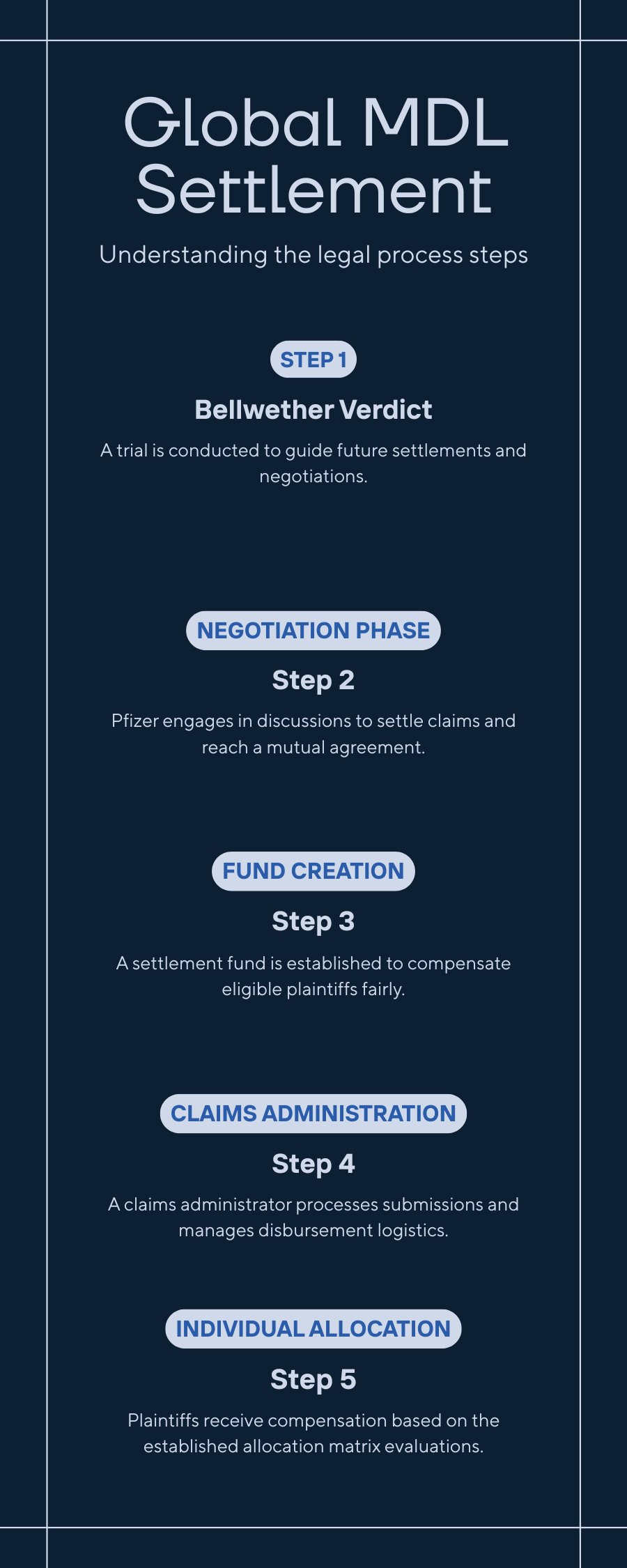
Global Settlement Announcement
Pfizer and the Plaintiffs' Steering Committee announce a global settlement agreement — a total dollar amount (e.g., "$X billion") and a framework for how it will be distributed. The settlement is filed with the court for approval.
Claims Administrator Appointed
A neutral third-party firm (e.g., BrownGreer, Epiq, or similar) is appointed to administer the settlement. They build the claims portal, collect plaintiff documentation, and apply the allocation matrix to calculate each award.
Plaintiff Enrollment Period
Your attorney submits your complete claim package — medical records, diagnosis documentation, pharmacy records, economic loss evidence. There is a deadline. Missing this deadline can result in exclusion from the settlement.
Allocation Matrix Applied
The claims administrator scores each claim using the allocation matrix. Factors include meningioma grade, surgical intervention, duration of Depo-Provera use, age, economic losses, and severity of ongoing impairment. Each plaintiff receives a point value; your share of the pool is proportional to your points.
Lien Resolution
Before disbursement, any medical liens must be resolved — Medicare, Medicaid, and private health insurer subrogation claims for medical bills they paid related to your meningioma. Your attorney negotiates these liens to minimize their impact on your net recovery.
Net Settlement Disbursement
After fees, costs, and lien resolutions, you receive your net settlement payment. Your attorney provides a settlement statement itemizing every deduction. You sign final release documents and receive your check or wire transfer.
The Allocation Matrix: What Factors Affect Your Share
Every plaintiff receives a different amount based on an allocation matrix that scores individual case factors. While the exact Depo-Provera matrix will be negotiated when the time comes, here's how comparable MDL matrices have worked:
| Factor | How It's Scored | Impact on Award |
|---|---|---|
| Meningioma Grade | Grade I / II / III tiers | High — primary tier driver |
| Surgical Intervention | None / Craniotomy / Repeat surgery | High — significant multiplier |
| Duration of Depo-Provera Use | Years of documented use | Moderate — confirms exposure |
| Cognitive/Permanent Impairment | Neuropsych test documentation | High — pain and suffering |
| Economic Losses | Medical bills + lost wages | Moderate — adds to economic tier |
| Age at Diagnosis | Younger = more years of impact | Moderate — affects future damages |
| Recurrence / Re-treatment | Documented additional interventions | High — ongoing burden |
Comparable Pharmaceutical Settlements: What History Shows
Roundup (Bayer/Monsanto) — $10.9 Billion
Settled approximately 100,000 cases alleging glyphosate caused non-Hodgkin's lymphoma. The science was contested, but multiple bellwether plaintiff verdicts accelerated settlement. Allocation was tiered by cancer type and severity.
J&J Talcum Powder — $6.9 Billion
Settled approximately 50,000 cases alleging asbestos-contaminated talc caused ovarian cancer and mesothelioma. Settled after multiple plaintiff trial verdicts and FDA regulatory pressure. Ovarian cancer cases and mesothelioma cases received different allocation tiers.
3M Combat Earplugs — $6.0 Billion
Settled approximately 250,000 cases involving hearing loss and tinnitus. The largest MDL in U.S. history by case count. Settlement occurred after multiple bellwether trials produced mixed results but plaintiff wins in significant number of cases.
Vioxx (Merck) — $4.85 Billion
Settled approximately 47,000 cases alleging Vioxx caused cardiovascular events. Settled after 11 bellwether trials produced 5 plaintiff wins. The $4.85B was distributed over several years through a tiered allocation system based on injury severity.
Past MDL settlements do not guarantee Depo-Provera MDL outcomes. These examples are provided for historical context only.
What You Keep: Understanding Deductions from Your Gross Settlement
| Deduction | Typical Amount | Who Receives It |
|---|---|---|
| Attorney contingency fee | 33–40% of gross | Your attorney |
| Case costs / litigation expenses | Varies ($500–$5,000+) | Third-party vendors |
| Medicare/Medicaid lien | Amount of medical bills paid | Federal government (negotiated down) |
| Health insurance subrogation | Varies by plan | Health insurer (often negotiated) |
| Your net recovery | Remainder after all deductions | You |
Frequently Asked Questions
Will Pfizer definitely settle the Depo-Provera MDL?
How is my individual settlement amount determined?
Do I have to accept the global settlement?
What is a claims administrator?
What should I do right now to be in the best position?
What happens to my settlement money before I receive it?
Related Depo-Provera Legal Guides
How Long Does a Depo-Provera Lawsuit Take?
A month-by-month filing-to-payout timeline showing every MDL phase.
Trial GuideThe December 2026 Bellwether Trial
How the first trial verdict shapes the global settlement negotiation.
Structure GuideClass Action vs. MDL: Which Gets You More?
Why MDL individual settlements are typically much larger than class action payouts.
Attorney GuideHow to Choose a Depo-Provera Lawyer
7 questions that separate great attorneys from average ones — before you sign anything.
The Settlement Process Starts With Filing. Start Now.
You cannot benefit from a global settlement if you never filed a claim. Every day you wait is a day your case isn't building. A free case review takes 20 minutes and costs you nothing — now or ever.
Get Your Free Case Review →Contingency fee — you pay nothing unless we win. No upfront costs. No obligation.