
Can You Get Disability Benefits for a Depo-Provera Meningioma? SSDI, FMLA, and Your Legal Rights
Published May 9, 2026
The Short Answer
Yes — women who cannot work due to a Depo-Provera meningioma may qualify for SSDI, FMLA leave, short-term disability, and long-term disability benefits. These are separate from your lawsuit. And critically: lost income you couldn't recover through disability benefits is also recoverable as damages in your Depo-Provera legal claim against Pfizer.
Donna's Story: Unable to Work After Surgery
Donna P. was 47 years old and a full-time registered nurse when she was diagnosed with a 2.8 cm meningioma in her right temporal lobe. She had been using Depo-Provera for eight years. The tumor was causing headaches and periodic confusion — symptoms she had attributed to stress and overwork. After an emergency MRI, she learned the truth.
Donna's craniotomy was successful, but recovery was harder than expected. Three months after surgery, she still couldn't process information quickly enough to work safely as a nurse. Her employer's HR department suggested FMLA, but she was approaching the 12-week limit with no clear return date. Her cognitive neurologist told her she might need six more months of rehabilitation.
"I thought I had to choose between getting better and going broke," Donna said. Her attorney helped her understand that she could pursue SSDI, use her employer's long-term disability plan, and file a Depo-Provera lawsuit simultaneously — and that every month she couldn't work was additional lost wages recoverable in her legal claim.
"I didn't realize I could pursue disability benefits AND a lawsuit at the same time. Learning that changed my entire financial situation during recovery."
Your Four Benefit Pathways Explained
1. Social Security Disability Insurance (SSDI)
SSDI pays monthly benefits to workers who have paid Social Security taxes and can no longer work due to a severe medical condition. For meningioma patients, this is the largest and most valuable long-term benefit source.
Who Qualifies
- • Worked and paid Social Security taxes for 5 of last 10 years
- • Condition prevents substantial gainful activity ($1,620/month in 2026)
- • Disability expected to last 12+ months
- • Meningioma with documented functional limitations
Key Facts
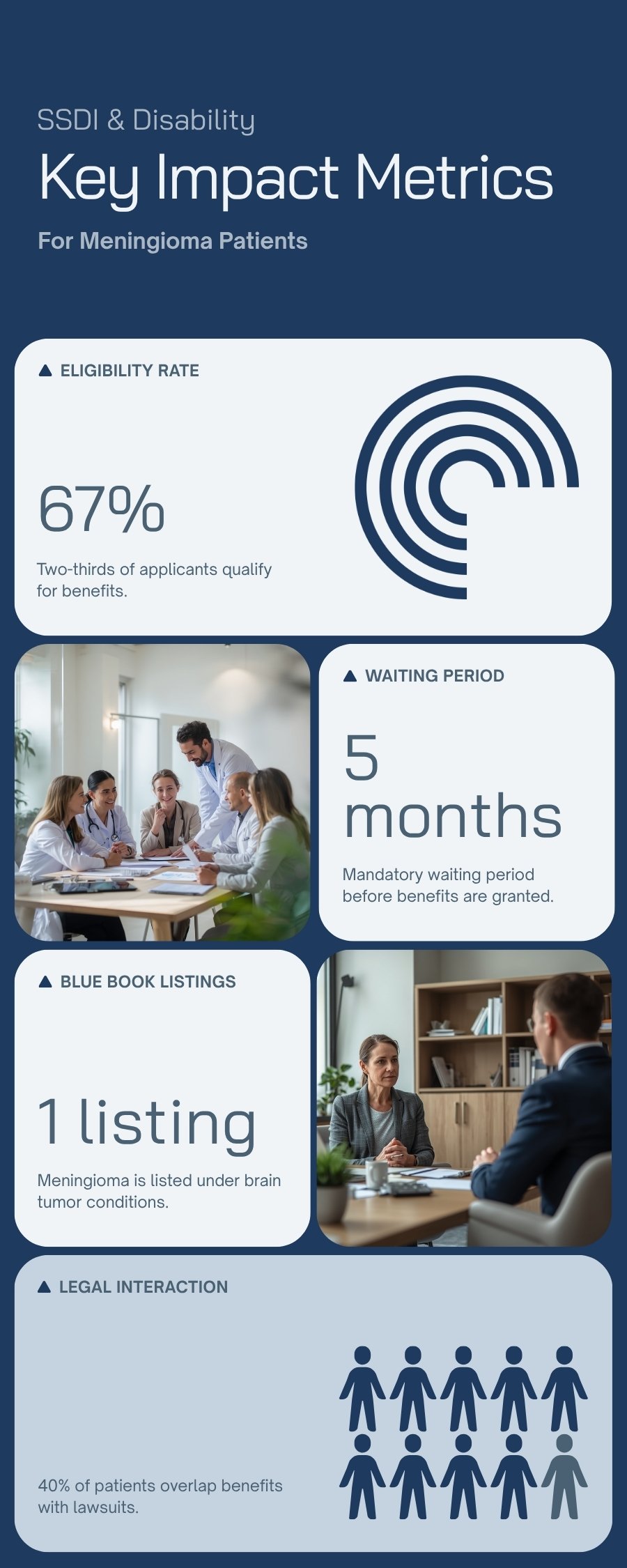
- • 5-month mandatory waiting period from disability onset
- • Average benefit: ~$1,537/month (2026)
- • Medicare eligible after 24 months on SSDI
- • ~67% of initial applications denied — appeal if denied
2. Family and Medical Leave Act (FMLA)
FMLA guarantees eligible employees up to 12 weeks of unpaid, job-protected leave per year for serious health conditions. For meningioma patients — particularly those undergoing surgery and rehabilitation — FMLA is typically the first line of protection.
FMLA Eligibility
- • Employer has 50+ employees within 75 miles
- • Worked for employer 12+ months
- • Worked 1,250+ hours in the past 12 months
- • Meningioma is a qualifying "serious health condition"
What FMLA Provides
- • 12 weeks of job protection (position held for your return)
- • Health insurance continuation at same cost
- • Can be taken intermittently (e.g., for treatments)
- • Can be taken continuously post-surgery
3. Short-Term Disability (STD)
Employer-provided STD insurance typically pays 60–70% of your salary for up to 3–6 months when a medical condition prevents you from working. For meningioma patients, STD often covers the immediate post-surgery recovery period when FMLA leave is exhausted or concurrent.
STD Quick Facts
4. Long-Term Disability (LTD)
LTD plans kick in when STD expires (typically after 3–6 months) and can continue paying 60% of salary for years — sometimes until retirement age. For patients with permanent cognitive or physical impairments from their meningioma, LTD is critical bridge income while SSDI is pending.
LTD Coordination with SSDI
Most LTD plans are "offset" — they reduce your LTD payment by the amount you receive from SSDI. This is why LTD carriers often help you apply for SSDI. The combined income support is typically the same, but the LTD insurer carries less risk once SSDI approves.
How Disability Benefits Interact With Your Lawsuit
One of the most common questions from Depo-Provera plaintiffs: "If I'm already getting disability payments, can I still sue Pfizer for lost wages?" The answer is yes — and here's why:
| Benefit Type | Reduces Lawsuit Value? | Creates Lien on Settlement? | Notes |
|---|---|---|---|
| SSDI | No | Medicare may | If Medicare paid medical bills, lien resolution required |
| FMLA | No | No | Job protection only — no cash payment |
| Short-Term Disability | Generally No | Generally No | Employer plan — not tied to lawsuit |
| Long-Term Disability | Generally No | Check your plan | Some LTD plans have subrogation rights — review with attorney |
| Health Insurance | No | Yes (subrogation) | Insurer may seek reimbursement for medical bills it paid |
Frequently Asked Questions
Does receiving SSDI affect my Depo-Provera lawsuit settlement?
How long does SSDI approval take for meningioma?
What is the 5-month SSDI waiting period?
Is my FMLA leave paid or unpaid?
Can I apply for disability and file a lawsuit at the same time?
If I can't return to my old job, does that affect my lawsuit value?
Related Depo-Provera Legal Guides
Meningioma Surgery: Before, During, and After
What craniotomy involves and how every surgical cost becomes recoverable in your lawsuit.
Evidence GuideWhat Evidence Do You Need?
Medical records, pharmacy records, and documentation for a strong Depo-Provera claim.
Timeline GuideHow Long Does a Depo-Provera Lawsuit Take?
A realistic filing-to-payout timeline — how long to plan your financial recovery around.
Symptoms GuideBrain Fog and Cognitive Symptoms Explained
How cognitive impairment from meningioma affects your disability eligibility and case value.
You Shouldn't Have to Choose Between Getting Better and Getting Paid.
Disability benefits support you now. A Depo-Provera lawsuit compensates you for everything Pfizer cost you. A free consultation helps you understand both — in 20 minutes, at no cost.
Get Your Free Case Review →Contingency fee — you pay nothing unless we win. No upfront costs. No obligation.