

Active Lawsuits Legal News Our Mission Free Case Review
Legal Analysis Depo-Provera May 8, 2026

Can I Sue My Doctor for Prescribing Depo-Provera? The Legal Line Between Pfizer and Your Physician

It is one of the most common questions from women diagnosed with meningioma after years on Depo-Provera: Was it Pfizer? Was it my doctor? Was it both? The answer matters — because it determines who you can hold accountable and what compensation you can pursue.

Both
Pfizer AND your doctor can be named defendants
2
Separate legal theories: products liability + negligence
$0
Upfront cost — contingency basis
Free
Consultation to assess your specific case
Can I sue my doctor for prescribing Depo-Provera showing scales of justice and legal accountability between Pfizer pharmaceutical company and prescribing physician

The Direct Answer: Yes — and So Can You Sue Pfizer

The short answer is: it depends on the specific facts of your case — but in many circumstances, yes, you can bring a claim against your prescribing physician. And critically, doing so does not prevent you from simultaneously pursuing claims against Pfizer. The two are legally independent and can be combined in a single lawsuit.

This guide explains the legal framework behind each type of claim, what you need to establish for each, and why most experienced Depo-Provera attorneys evaluate both routes before advising their clients.

"The question of whether to sue the doctor, the drug company, or both isn't a philosophical one — it is a strategic one. We evaluate both avenues in every case, because they often run on parallel tracks and each can add significant value to the overall recovery."

— General principle from pharmaceutical mass tort litigation practice, 2025

Two Legal Tracks: Products Liability vs. Medical Negligence

Understanding why these are treated as separate claims is essential — because the legal standards, evidence requirements, and defendants are different for each.
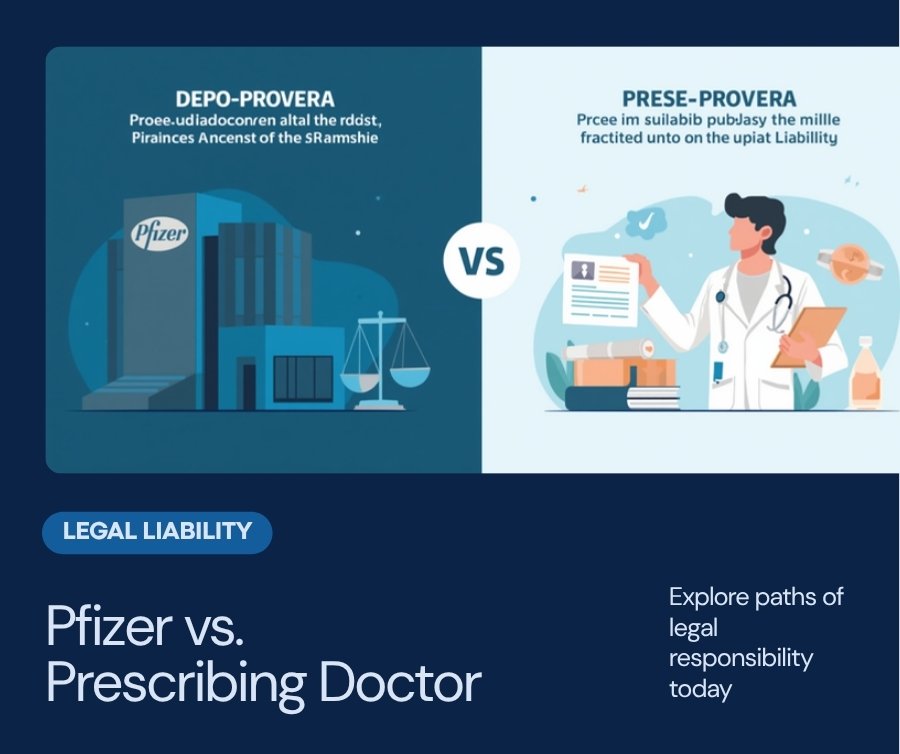
Depo-Provera liability comparison diagram showing the difference between Pfizer pharmaceutical company products liability and prescribing doctor medical negligence legal claims
Two distinct legal pathways — products liability against Pfizer and medical negligence against your physician — can be pursued simultaneously
factory
Track 1: Sue Pfizer
Products Liability
Legal theory: Pfizer manufactured and sold a defective product that carried inadequate warnings about a known serious risk
What you must prove: You used Depo-Provera; it caused your meningioma; Pfizer knew of the risk and failed to adequately warn; your damages
Doctor's conduct: Irrelevant — this claim focuses on the manufacturer, not your physician
Strength of claim: Very strong — supported by decades of scientific literature, FDA warning label issued 2024, and 3,500+ federal cases filed
stethoscope
Track 2: Sue Your Doctor
Medical Negligence
Legal theory: Your physician failed to meet the standard of care by prescribing without adequate disclosure of known risks (informed consent failure) or by continuing to prescribe despite red flags
What you must prove: Standard of care at time of prescribing; your doctor deviated from it; that deviation caused your harm
Pfizer's conduct: Relevant — if Pfizer's label was inadequate, this affects what information doctors had available
Strength of claim: Fact-specific — depends on when you were prescribed, what was in medical literature at the time, and what disclosures your doctor did or did not make

Pfizer's Main Defense: The "Learned Intermediary" Doctrine

One of the first legal concepts you will encounter in a Depo-Provera case is the learned intermediary doctrine — and understanding it is critical to understanding how both Pfizer and your physician relate to each other legally.

The doctrine works like this: pharmaceutical companies generally do not have a duty to warn patients directly about drug risks. Instead, their duty runs to the prescribing physician — the "learned intermediary" — who is responsible for evaluating the drug's risks and benefits and communicating relevant information to the patient.

What this means in practice for your case:
arrow_forward
Pfizer argues: "We warned doctors. Your doctor failed to pass the warning along. That's a doctor problem, not ours."
This is their primary defense in product liability cases involving drug risks.
gavel
The counter-argument: Pfizer's warnings were themselves inadequate — so even the learned intermediary had deficient information.
If the label didn't adequately warn doctors of the meningioma risk, the learned intermediary doctrine doesn't protect Pfizer. Courts have accepted this argument in multiple Depo-Provera cases.
balance
The result: Often both parties bear responsibility — Pfizer for inadequate label warnings and your doctor for failing to communicate even what was available.
Courts apportion fault between defendants — meaning both can be held financially responsible for their share of the harm.

When Your Doctor May Be Independently Liable

Even setting aside Pfizer's conduct, your prescribing physician may have independent liability if any of the following apply:

article
Medical literature on progestin and meningioma was available — and your doctor should have known it

Peer-reviewed studies linking progestins to meningioma growth have existed since the 1980s. Physicians who stayed current with oncology and endocrinology literature had access to this information well before the FDA's 2024 label update. If your doctor prescribed Depo-Provera for years without awareness of this literature, that may constitute a deviation from standard of care.

warning
Your doctor continued prescribing after neurological symptoms emerged

If you reported headaches, vision changes, or other neurological symptoms — and your doctor failed to consider Depo-Provera as a contributing factor and continued prescribing — this can support an independent negligence claim beyond simple failure-to-warn at initial prescription.

group
No informed consent process occurred

If your medical records show no documented informed consent discussion — or if the discussion omitted material risks that a reasonable patient would have considered significant — this is evidence of an informed consent failure that supports a malpractice claim separate from any products liability claim against Pfizer.

Important: Your doctor may not have known

In many cases, doctors genuinely did not know about the meningioma risk — because Pfizer's label was inadequate and they were not following specialized endocrinology literature. If your doctor was reasonably relying on Pfizer's label (even if that label was deficient), their independent liability may be limited. An attorney will evaluate the specific timeline and your doctor's prescribing conduct to assess this.

Practical Guidance: What to Do Before Consulting an Attorney

task_altDo these things now
  • Request your complete medical records from all prescribing physicians
  • Note the start and end dates of every Depo-Provera injection period
  • Write down everything you remember about informed consent discussions (or lack thereof)
  • Gather your meningioma diagnosis records and imaging reports
  • Document all treatment costs — surgery, radiation, medications, lost income
blockDo NOT do these things
  • Do not confront your doctor or express legal intent before consulting an attorney
  • Do not assume your doctor committed malpractice — let an attorney evaluate objectively
  • Do not sign any settlement or release from your doctor's office or insurer without legal review
  • Do not wait — statutes of limitations apply, and the sooner you consult an attorney, the better

Related Depo-Provera Guides

Frequently Asked Questions

Can I sue my doctor for prescribing Depo-Provera and causing my brain tumor?expand_more
Potentially yes, but the answer depends on specific facts. To hold a physician liable, you generally need to show they prescribed Depo-Provera without adequately disclosing known material risks or that their prescribing decision deviated from the standard of care. This is separate from — and in addition to — a claim against Pfizer for manufacturing a defective product with inadequate warnings.
Is it better to sue Pfizer or my doctor for Depo-Provera meningioma?expand_more
Most attorneys recommend naming both defendants when the facts support it. Claims against Pfizer and your physician are separate and can be pursued simultaneously. Pfizer has substantially greater financial resources, but physician liability claims can add significant additional recovery depending on your state and the specific facts of your case.
What does the learned intermediary doctrine mean for my case?expand_more
The learned intermediary doctrine is a legal defense Pfizer uses to argue their duty to warn ran to your doctor — not directly to you — and that warning physicians satisfies their obligations. However, courts have rejected this defense in Depo-Provera cases where the label warnings were themselves inadequate. If Pfizer failed to warn doctors properly, the doctrine does not protect them.
What evidence do I need to sue my doctor for Depo-Provera?expand_more
Key evidence includes your complete medical records showing all Depo-Provera prescriptions, documentation of what consent disclosures were or weren't made, records showing when your meningioma was diagnosed, and expert medical testimony on the standard of care at the time of prescribing. An attorney will gather most of this through the discovery process — you don't need it all before your free consultation.
Does suing Pfizer affect my ability to also sue my doctor?expand_more
No — these are separate legal claims that can be pursued simultaneously in the same lawsuit. You can name both Pfizer and your physician as defendants. They are heard together and damages from each defendant are assessed separately based on their degree of fault. Pursuing one does not limit or forfeit the other.
Free Confidential Evaluation

The Answer to "Can I Sue?" Starts With a Free Consultation

Every Depo-Provera case is different. An experienced attorney will evaluate whether claims exist against Pfizer, your doctor, or both — and give you a clear picture of your options at no cost.

gavel Get a Free Case Evaluation

No fees unless we win. Available 24/7. Completely confidential.